You assessed your vendor. You reviewed the contract. You checked the security credentials.
But have you ever asked your vendor one simple question?
“Who else has access to our customers’ data because of you?”
Imagine that your organization has partnered with a trusted service provider to manage customer support. Your team completes its due diligence, approves the vendor, and moves forward.
Everything looks secure.
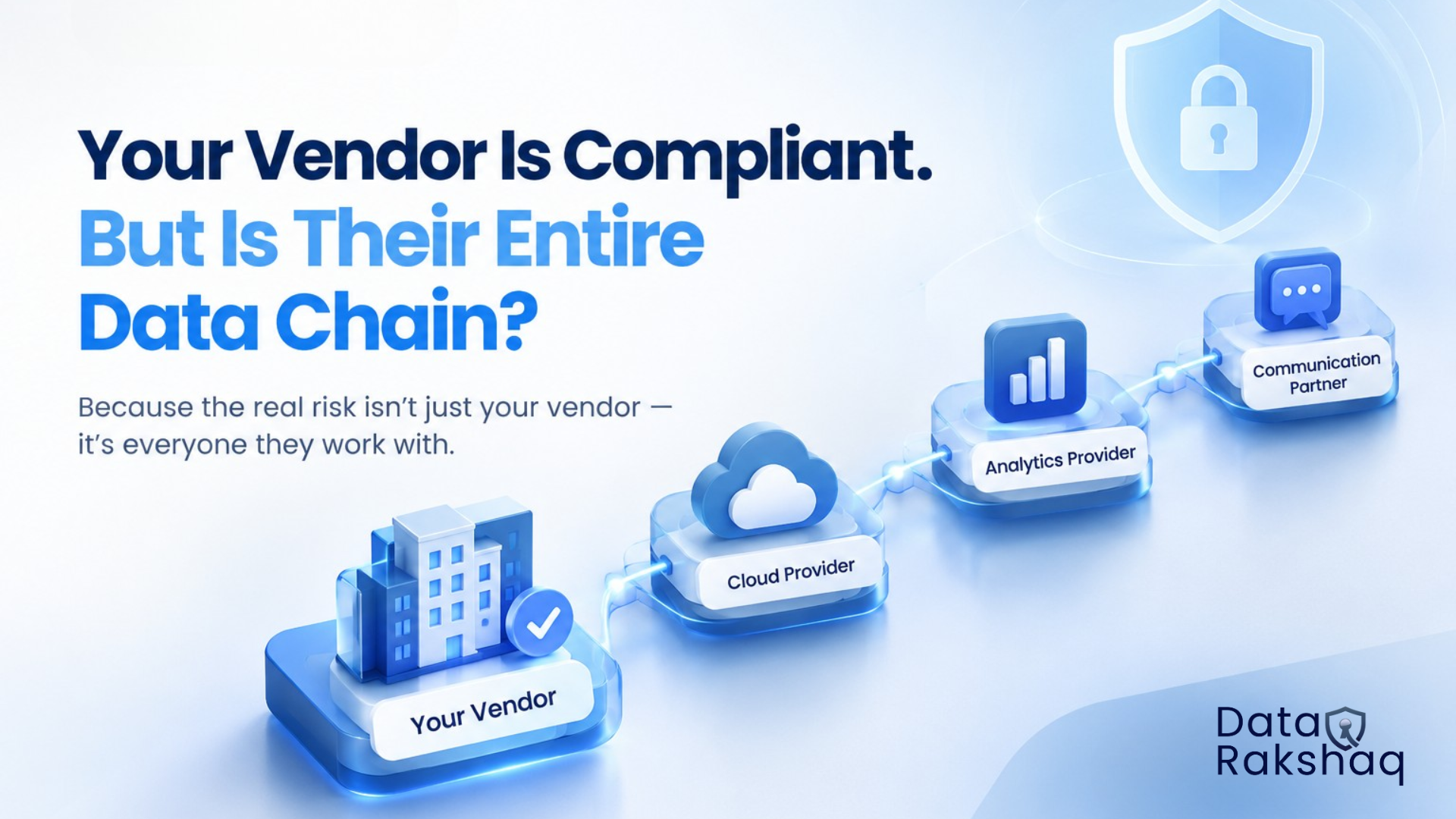
Then you discover that your vendor uses another company to host customer records, a separate platform to analyses interactions, and an external service provider to send customer communications.
Your organization never assessed these companies directly.
Now ask yourself: If one of those companies mishandles your customers’ personal data, how prepared would your organization be to respond?
Would you know which data was involved? Who had access to it? Which safeguards applied? Who would inform you if something went wrong?
Or would your team begin searching through contracts, emails, spreadsheets, and unanswered messages?
This is the blind spot behind third-party data risk.
You may trust the company you hired. But can you see the entire chain of companies handling your data?
The Vendor You Approved May Not Be the Whole Story
Let’s take a real-world-style example.
A lending company works with an outsourced customer support provider. The provider needs access to certain customer details to resolve queries.
The lending company reviews the provider’s security controls and signs an agreement.
However, the support provider also relies on a cloud platform, an analytics service, and a communications partner.
Each relationship raises new questions:
Does each provider receive personal data, and if so, what information?
Is the data being used only for the intended purposes?
Are appropriate contractual and security safeguards in place?
Can the lending company obtain relevant information if an incident occurs?
Are changes to downstream providers being reviewed?
Here is the uncomfortable part: the lending company may have done its initial vendor assessment correctly and still lack visibility into the wider processing chain.
This is where fourth-party risk enters the picture—the risk associated with your vendors’ own service providers and other downstream dependencies.
The lesson is not that every vendor or sub-processor is dangerous.
It is that a risk you cannot see is a risk you may not be prepared to manage.
What Would Happen If One Link in the Chain Failed?
Consider three situations.
Scenario A: A downstream provider experiences a data breach.
Your primary vendor informs you that an incident has occurred. Can your team quickly establish whether your customers’ personal data was affected, what information is available, and which response steps are required?
Scenario B: Your vendor introduces a new sub-processor.
The service continues working normally, so nobody pays much attention. But the new provider changes where data is processed, who can access it, or how information is retained.
Would your organization know that its risk profile has changed?
Scenario C: An auditor asks you to demonstrate your oversight.
Your team has the original contract and a complete vendor questionnaire. But can it also explain the downstream processing relationships, the safeguards reviewed, the risks identified, and the action taken when gaps were found?
These scenarios reveal three different weaknesses: incident readiness, change management, and evidence.
Which one would be hardest for your organisation to handle today?
That question matters because vendor governance is not tested only when a supplier is onboard. It is tested when circumstances change.
Why This Matters for NBFCs and Fintechs
Financial services organizations depend on interconnected providers for customer onboarding, KYC workflows, lending operations, fraud detection, cloud infrastructure, analytics, communications, and customer support.
That creates a complex ecosystem in which personal data may move across multiple systems and organizations.
Three problems often make this difficult to govern.
The visibility problem: Different teams may hold different pieces of the picture. Procurement knows the vendor, IT understands the integration, legal managements the contract, and privacy teams maintain processing records. No single view may connect all of them.
The accountability problem: Outsourcing a processing activity does not automatically remove the Data Fiduciary’s responsibilities under the applicable legal framework. Organisations need to understand their obligations and establish appropriate contracts, safeguards, and oversight.
The evidence problem: It is one thing to say that vendors are assessed. It is another to demonstrate what was assessed, when it was reviewed, what risks were identified, and how those risks were addressed.
For BFSI leaders, the question is not simply, “Have we completed vendor due diligence?”
It is:
“Can we demonstrate that our oversight keeps pace with the way our vendors actually process data?”
What Does the DPDP Act Mean for Your Vendor Relationships?
India’s Digital Personal Data Protection Act, 2023, makes vendor governance an important part of a Data Fiduciary’s approach to protecting personal data.
Section 8(2) addresses the engagement of a Data Processor on behalf of a Data Fiduciary through a valid contract. Section 8(5) addresses reasonable security safeguards, including where processing is undertaken by a Data Processor on the Data Fiduciary’s behalf.
For organizations, this means vendor governance should go beyond collecting a security certificate or signing an agreement.
It should include an understanding of:
What personal data is being processed and for which purposes.
Which providers are involved in that processing.
Whether relevant contracts and safeguards reflect the actual arrangement.
How incidents and material changes will be communicated.
How the organization will document its assessments and decisions.
The precise obligations depend on the circumstances and the applicable legal provisions and rules in force.
The practical takeaway is straightforward: a signed contract is evidence of an agreement, not proof that every risk across the data chain has been identified and managed.
Five Questions to Ask Before Trusting Your Vendor's Data Chain
Instead of asking only whether a vendor is compliant, consider asking these five questions.
Question 1: Who else processes our data?
Ask the vendor to identify relevant sub-processors and explain their roles in delivering the service.
If the answer is incomplete, determine what additional information you need before making a risk decision.
Question 2: Does our assessment reflect how the service works today?
A vendor may have introduced new systems, integrations, or service providers since the original assessment.
Review material changes and establish risk-based reassessment triggers.
Question 3: Do our contracts match the actual data flows?
Compare the documented arrangement with the processing activities that occur in practice.
Investigate discrepancies and agree on corrective actions where necessary.
Question 4: Can we respond if a downstream provider has an incident?
Establish escalation contacts, notification expectations, information-sharing arrangements, and responsibilities. Test whether the people involved know what to do.
Question 5: Can we prove what we did to manage the risk?
Maintain relevant assessment records, contractual information, processing details, review outcomes, and remediation evidence in a form authorized teams can retrieve.
These questions do not eliminate third-party risk. They help turn a broad concern into specific actions your organization can take.
From Vendor Approval to Continuous Governance
Here is an important distinction.
Vendor approval is a decision. Vendor governance is an ongoing process.
A vendor may have been suitable when the relationship began. Its technology, sub-processors, access permissions, or processing activities may change over time.
That is why organisations need a repeatable process:
Identify → Map → Assess → Safeguard → Monitor → Evidence
First, identify the providers involved in processing personal data. Then map the data, purposes, and relevant systems. Assess the risks based on actual exposure. Establish appropriate contractual and security safeguards. Monitor material changes and incidents. Finally, maintain evidence that explains the decisions and actions taken.
Not every vendor requires the same level of scrutiny. A risk-based approach helps organisations prioritise relationships according to the data involved, access granted, service dependency, and potential impact.
The goal is not to create paperwork for every supplier.
The goal is to know where meaningful risks exist—and what your organisation is doing about them.
How DataRakshaq Can Help You Strengthen Data Governance
A framework becomes more useful when teams can connect data, processing activities, compliance work, and supporting evidence.
DataRakshaq supports this through several privacy governance capabilities.
Data Lens: Discover and classify personal data
You cannot properly assess exposure if you do not understand where personal data resides. DataRakshaq’s Data Lens capabilities support discovery and classification across connected data environments, helping teams build a clearer view of relevant data assets.
That information can support investigations into what data is shared with external providers. The completeness of the view depends on connected systems and the information available.
RoPA: Connect processing activities with business purposes
Records of Processing Activities help organizations document how personal data is processed. DataRakshaq’s RoPA capabilities support structured records that can be considered alongside vendor inventories, contracts, and other processing documentation.
This helps teams identify where information needs to be reviewed or clarified.
DPO Command Centre and Governance: Bring ownership into the process
Third-party risk involves several teams. DataRakshaq’s governance capabilities support more structured oversight of privacy and compliance activities, helping organizations coordinate responsibilities, track identified gaps, and manage remediation workflows.
Breach Management: Support incident coordination and evidence
If an incident involves a vendor or downstream provider, teams need to organize information, coordinate response activities, and assess their obligations. DataRakshaq’s breach management capabilities support structured incident handling and evidence management.
Organizations must still establish effective communication and escalation arrangements with their providers.
Analytics and reporting: Make gaps easier to review
Compliance decisions are more useful when teams can understand outstanding issues and communicate progress. DataRakshaq’s analytics capabilities support visibility into compliance activities and identified gaps, helping teams organize their governance work.
The important distinction is that a platform supports the process; it does not automatically uncover every sub-processor, certifies every vendor, or guarantee compliance. Organizations must validate information, conduct appropriate assessments, and act.
The objective is to move from disconnected vendor information to a more connected, evidence-led approach to data governance.
The Question Every Business Leader Should Be Asking
Imagine that tomorrow your board asks:
“We trust our vendors. But how do we know that the companies behind them are handling our customers’ data appropriately?”
Would your team be able to present a clear picture of the relevant providers, the data involved, the risks assessed, and the actions taken?
Or would the answer require several teams to spend days assembling the evidence?
There is no shame in discovering a gap. The bigger risk is assuming that everything is under control simply because the first vendor passed its assessment.
Start by choosing one critical vendor. Ask for its relevant sub-processor information. Map the data involved. Review the applicable safeguards. Identify what remains unknown, assign responsibility, and document the next steps.
One relationship can reveal how well your wider governance process works.
Conclusion: Trust Is Important. Visibility Is Essential.
Your vendor may be trustworthy. Its security team may be experienced. Its certifications may be valuable.
But none of those facts, on their own, tells you everything about the organizations and systems involved in processing your customers’ data.
In a connected business environment, protecting personal data requires more than evaluating the company you signed a contract with. It requires understanding the wider chain, reviewing changes, managing risk, and being able to explain your decisions.
Because the question is no longer just, “Do we trust our vendor?”
It is:
“Can we see, understand, and govern the entire chain that handles our customers’ data?”
DataRakshaq helps organizations strengthen their approach to data discovery, processing records, privacy governance, breach management, and compliance reporting.