India's push toward real data privacy is reshaping the job market in a way most companies didn't see coming. As organizations wrestle with increasingly complex data environments and the rapid, often uncontrolled adoption of AI across their systems, a new category of technical talent is emerging — people who can turn a regulation into working software, not just a slide deck. The Digital Personal Data Protection (DPDP) Act is at the center of this shift, and as it moves from statute toward active enforcement, companies are running into an uncomfortable truth: writing a privacy policy and making your technology obey it are two entirely different jobs.
From Compliance Advisory to Compliance Engineering
Privacy has historically been the domain of legal, compliance, and cybersecurity teams — people who write policy, assess risk, and interpret regulation. That's no longer where the hard work sits. The real difficulty now is technical: building the structured controls that make consent, access, retention, and deletion actually function inside live production systems, not just describing what those controls should look like on paper.
This is a fundamentally different skill set than the one most privacy programmes were staffed for, and it's creating a real shortage. Advisory work — gap assessments, policy documents, DPDP-readiness scoring — is everywhere. Engineering the systems that make those policies true is what's genuinely scarce. Very few providers can walk in and actually build the technical plumbing a compliance policy assumes already exists.
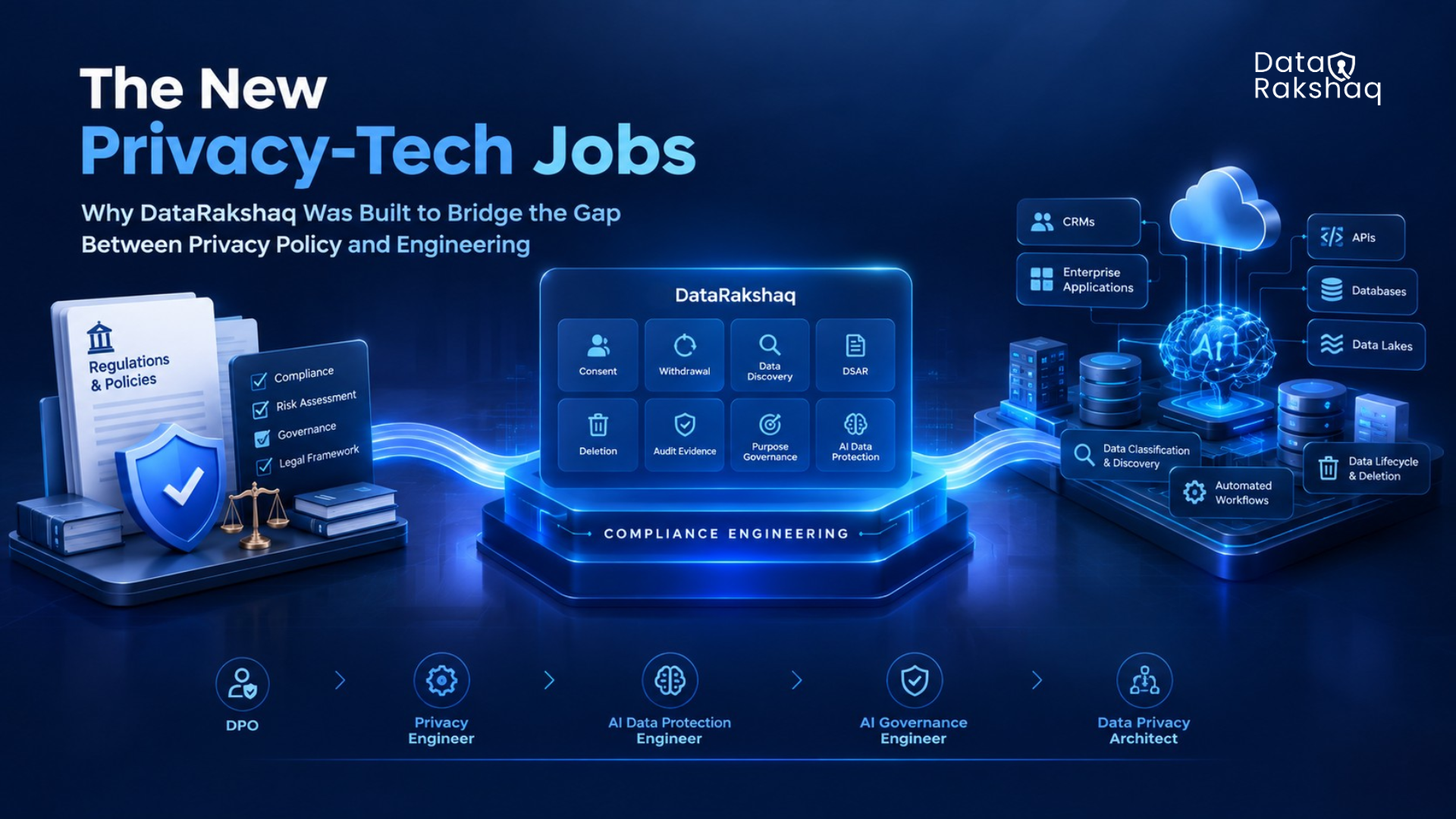
DataRakshaq exists precisely in that scarce middle ground — not another advisory layer telling a BFSI or NBFC organization how far from compliant it is, but a platform that builds the engineering layer directly: consent capture, withdrawal enforcement, and deletion workflows that plug into existing systems rather than sitting beside them as one more thing to configure.
The Roles This Shift Is Creating
Data Protection Officer (DPO) - Leads an organisation's data-protection governance, compliance, and regulatory engagement
Privacy Engineer - Builds technical controls for consent, access, retention, deletion, and privacy-by-design.
AI Data Protection Engineer - Uses AI/ML to discover, classify, and protect sensitive and personal data.
AI Governance Engineer - Builds technical guardrails, monitoring, and controls around AI systems and agents.
Data Privacy Architect - Designs enterprise systems and data platforms with privacy and data-protection requirements built in.
Five specialized hires is a tall order for most Indian financial institutions trying to get DPDP-compliant on a realistic budget and timeline. That gap between what compliance now requires and what most organizations can staff for is exactly where DataRakshaq positions itself — doing the work of several of these roles through one platform rather than five separate job requisitions.
Why Consent Withdrawal Is Harder Than It Sounds
The difficulty of this shift becomes obvious the moment a company tries to implement something that sounds simple: letting a customer withdraw consent. Most organizations have spent 15 or 20 years building out data infrastructure — layers of systems, databases, and integrations — with no consent mechanism designed into any of it from the start. Making consent withdrawal or data erasure propagate through those production systems can mean partially rebuilding data flows nobody has touched in years.
DataRakshaq's consent management module is built specifically to avoid that rebuild. Rather than demanding a company re-architect its infrastructure to support consent logic, DataRakshaq plugs into existing CRMs, databases, and enterprise applications, so withdrawal and downstream deletion are handled without ground-up systems overhaul.
Proving It Happened, Not Just Saying It Did
Beyond building the controls, organizations are struggling to demonstrate that those controls work. If a regulator asks whether a company deleted a customer's personal data, "we believe so" isn't an answer — the organization needs evidence that the deletion genuinely happened. Tools for consent, cookie management, and data mapping are emerging across the market, but implementing privacy technology properly remains an ongoing, unfinished journey for most companies, not a problem anyone has fully solved yet.
This is exactly the gap DataRakshaq's tamper-proof consent ledger is designed to close. Every consent, withdrawal, and erasure is logged the instant it happens, so instead of scrambling to reconstruct a compliance history after the fact, an organization can produce a verifiable record on demand — turning "we believe we deleted it" into "here's the log proving we did."
Legacy Infrastructure Wasn't Built for Any of This
Older technology makes the whole problem harder still. Mainframes and COBOL-based databases were designed decades before anyone thought about consent withdrawal or data-lifecycle management — they simply have no native concept of "this record must be delectable on request." Bridging that gap usually requires custom engineering most organizations can't staff internally, which is why DataRakshaq's API-first design is built to sit alongside legacy systems rather than force their replacement — a realistic path for BFSI and NBFC institutions running infrastructure that predates the DPDP Act by decades.
AI Has Changed the Question Privacy Teams Need to Ask
AI adds a layer of complexity that most existing privacy programmes were never designed to handle. Modern AI systems can combine multiple pieces of legitimate, individually harmless data to infer something a customer never actually disclosed with, a fact, a preference, even a vulnerability the person never shared directly. That shifts the core privacy question from "who is allowed to access this data?" to "what are we allowed to infer from it?"
As AI becomes more deeply embedded across enterprise systems, privacy architecture has to evolve to match — moving from simply protecting stored data to actively governing what a system is permitted to conclude from it. Just because a model can infer something doesn't mean an enterprise should know it, or act on it.
DataRakshaq addresses this by treating consent as purpose-bound rather than merely data-bound: it records not only what data was collected, but the specific purpose it was collected for, and flags when a new use — including an AI-driven inference — falls outside that original purpose. That's the DPDPA's purpose limitation principle, applied directly to a problem regulators are only beginning to grapple with.
Why This Matters More for BFSI and NBFC Than Anywhere Else
Financial institutions sit at the intersection of every problem described here: decades-old core banking infrastructure, enormous volumes of consent-sensitive data, and increasing pressure to deploy AI for credit scoring, fraud detection, and personalization — each of which raises exactly the inference question above. That combination makes BFSI and NBFC organizations the sector where the gap between policy and engineering is widest, and the cost of getting it wrong is highest, given the DPDPA's steep penalty structure.
The Bottom Line
India's privacy-tech talent shortage isn't closing anytime soon — Privacy Engineers, AI Governance Engineers, and Data Privacy Architects will only be in higher demand as DPDP enforcement matures and AI adoption accelerates. But BFSI, NBFC, and Fintech organizations don't have to wait to build that team from scratch or gamble on a hiring market this tightly. DataRakshaq was built to do engineering work these emerging roles exist to perform — consent enforcement, verifiable evidence, legacy-system integration, and purpose governance — as one connected platform, available now, rather than a headcount plan for later.