Consent is no longer a checkbox. It is becoming an enterprise-wide data governance capability.
For years, many organisations have treated consent as simple interaction:
Show a notice → tick a box → store the response → move on.
But modern data ecosystems are far more complicated.
A single customer's data may move from a website or mobile application into a CRM, analytics platform, communication system, data warehouse, lending platform, support application and multiple third-party processors.
Now imagine that customers change their consent preference.
Can your organisation identify every system affected?
Can processing be stopped where required?
Can you prove exactly what the individual consented to?
Can you show which notice they saw when they gave that consent?
These questions highlight why consent management is moving beyond the front end.
With India's DPDP framework and the DPDP Rules, 2025 establishing a formal framework for Consent Managers, organisations need to think about consent as an ongoing, traceable and governed lifecycle. The Rules describe a Consent Manager as an interoperable platform through which Data Principals can give, manage, review and withdraw consent.
But for enterprises, the bigger question is:
Is your internal consent architecture ready for this new era?
From Consent Capture to Consent Governance
Consent should not begin and end with a button.
A mature consent process needs to answer the complete chain:
Why are we collecting the data?
↓
What did we tell the individual?
↓
What did they agree to?
↓
Where is that consent applicable?
↓
Is the consent still valid?
↓
What happens if they withdraw it?
↓
Can we take every step?
This is where traditional consent mechanisms begin to fall short.
A spreadsheet may tell you that someone opted in.
An application database may tell you when they opted in.
A CRM may show their current preference.
But unless these pieces are connected, the organisation may still lack a complete and reliable consent record.
Consent without visibility creates risk.
Consent with governance creates accountability.
Why the Consent Manager Era Matters
The DPDP Rules, 2025 introduce specific provisions around Consent Managers.
According to the Ministry of Electronics and Information Technology's explanatory note, a registered Consent Manager is expected to provide an interoperable platform through which Data Principals can give, manage, review and withdraw consent, while maintaining records of consent and data sharing and providing transparent access to those records.
This represents an important shift in the privacy ecosystem.
Consent is increasingly being viewed as something that must be:
understandable
purpose-specific
traceable
manageable
withdrawable
secure
evidenced
For enterprises, this means consent architecture can no longer sit separately from the rest of the privacy programme.
It needs to connect with data discovery, processing activities, notices, data principal rights, vendors, retention and governance.
The Real Challenge: What Happens After “I Agree”?
Getting someone to click “Accept” is only the beginning.
The real complexity starts afterwards.
Consider a customer who provides consent for marketing communication.
Six months later, they withdraw that consent.
The organisation now needs to know:
Where is the consent recorded?
Which marketing systems received it?
Which processors are using the data?
Which campaigns need to stop?
Has the withdrawal reached downstream systems?
Can the organisation demonstrate that it acted on the withdrawal?
This is why modern consent management needs to move from recording decisions to operationalising decisions.
Five Capabilities of a Strong Consent Architecture
1. Purpose Must Come Before Consent
Consent is meaningful only when the individual understands why their data is being collected.
A generic “I agree to the processing of my data” approach does not provide the same level of clarity as purpose-specific consent.
DataRakshaq addresses this through its Purpose Registry, which acts as a central repository for processing purposes, including purpose descriptions, legal-basis mapping, associated data and processor relationships.
Its consent architecture is built around granular, purpose-based consent so that different processing purposes can be governed independently.
For example:
Service communication ≠ Marketing ≠ Analytics
Each requires different governance.
2. The Notice and Consent Must Stay Connected
A consent decision cannot be separated from the information presented to the individual.
The DPDP Rules require notices to be clear, standalone and understandable, including information about the personal data being collected and the purpose of processing. They also provide easy withdrawal mechanisms.
That makes notice management an important part of consent architecture.
DataRakshaq connects its Purpose Registry with its Notice Management capabilities so organisations can create, manage, version and audit purpose-linked notices.
The platform supports notice delivery across channels including web, mobile, email, SMS, API and WhatsApp/chatbot workflows.
This creates a connected journey:
Purpose → Notice → Consent
instead of maintaining three disconnected processes.
3. Consent Must Be Manageable Throughout Its Lifecycle
Consent is not necessarily permanent.
It can be:
Given → Updated → Withdrawn → Expired → Renewed
DataRakshaq's Consent Management module is designed around this lifecycle.
Its Consent Profiles maintain purpose-level consent status and history, while applications can check consent status through APIs before processing data.
The platform also supports downstream propagation through webhooks, helping organisations operationalise consent changes across connected systems.
That distinction is critical.
Recording a withdrawal is not the same as enforcing a withdrawal.
A mature privacy programme needs to do both.
4. Every Consent Decision Needs Evidence
Imagine a regulator, auditor, customer or legal team ask:
“Show us what this individual actually consented to.”
Can your organisation produce the answer?
Not just a database entry.
Not just a timestamp.
But the complete context.
DataRakshaq addresses this through Consent Artifacts — timestamped, cryptographically signed records designed to capture evidence around consent events. The Consent Management guide describes information such as the event type, notice version, purpose, timestamp and channel associated with the consent event.
This transforms consent from:
“We think they agreed.”
into:
“Here is the evidence of what they agreed to.”
That is a significant difference when organisations need audit-ready accountability.
5. Consent Must Connect with the Rest of Your Data Ecosystem
Consent cannot operate in a silo.
It needs to connect with the systems and processes that use personal data.
That includes:
Data Discovery
Identify where personal data exists and whether appropriate consent is associated with processing.
RoPA
Connect consent purposes with processing activities and processors.
DSAR
Use consent history when responding to data access, correction or erasure requests.
Vendor Governance
Understand whether third-party processing remains within the authorized purpose.
Retention & Deletion
Trigger appropriate downstream lifecycle actions when consent or retention conditions change.
Breach Management
Use consent and processing context to support impact assessment.
DataRakshaq's platform architecture brings these capabilities together through a unified DPDP compliance platform and shared compliance layer.
How DataRakshaq Helps Build a Consent-Ready Enterprise
This is where DataRakshaq moves beyond a basic consent collection tool.
DataRakshaq is positioned as an end-to-end DPDP compliance platform, with Consent Management as one of its core modules alongside Data Discovery & Classification, RoPA, DSAR, Notices, DPIA, Breach Management, Governance and other capabilities.
01. Build a Central Purpose Registry
Instead of managing processing purposes across scattered documents and teams, DataRakshaq provides a centralized Purpose Registry.
It connects purposes with:
Data involved
Legal basis
Retention requirements
Processors
Governance information
This creates a clearer foundation for purpose-based consent.
02. Capture Consent Across Multiple Channels
Enterprise customers do not interact through one channel.
DataRakshaq supports consent experiences across:
Web | Mobile | Email | WhatsApp | IVR/API | Offline
This helps organisations bring consent management into the actual customer journeys where data is collected.
03. Manage Consent at Purpose Level
Instead of treating an individual's consent as one universal status, DataRakshaq enables organisations to maintain purpose-level consent records.
This allows organisations to distinguish between:
What the individual accepted
and
What the organisation is authorised to process.
04. Make Withdrawal Operational
A privacy preference is useful only if the organisation can act on it.
DataRakshaq supports consent withdrawal and downstream propagation through integrations and webhooks, helping organisations communicate changes to dependent systems.
This turns withdrawal from a manual privacy-team task into an operational workflow.
05. Create Tamper-Resistant Evidence
Every important consent event needs an audit trail.
DataRakshaq generates consent artifacts with timestamps and cryptographic evidence, creating a structured record of consent-related actions.
This supports a more evidence-driven approach to DPDP governance.
06. Connect Consent with Broader DPDP Compliance
Consent should not become another isolated data silo.
DataRakshaq connects consent management with other privacy workflows, including Data Discovery, Data Principal Rights, Vendor/Processor Management, Retention & Deletion and Breach Management.
That means organisations can move toward a single privacy architecture rather than managing separate tools for every obligation.
Consent Management for BFSI & High-Trust Industries
For BFSI, fintech, lending and other highly regulated sectors, consent can become particularly complex.
Consider a digital lending journey.
A customer may interact with:
Onboarding → KYC → Credit Bureau → Loan Processing → Communication → Collections
Each stage can involve different processing purposes, systems and third parties.
A strong consent architecture needs to understand those relationships.
DataRakshaq provides sector-specific purpose libraries and workflows for BFSI and fintech, including use cases around onboarding, marketing communication and lending-related consent.
This sector-specific approach can help organisations avoid starting their DPDP programme from a blank page.
What Should Enterprises Do Now?
The goal should not be to wait for a regulatory deadline and then replace a checkbox with a new consent tool.
Instead, organisations should start asking:
1. Where is consent collected today?
List every customer, employee and partner journey where personal data is collected.
2. What purposes are linked to that consent?
Identify whether each consent is genuinely purpose specific.
3. Can you trace consent downstream?
Map the applications, processors and systems that rely on the consent.
4. What happens when consent is withdrawn?
Test whether the change reaches downstream processing systems.
5. Can you prove the consent?
Check whether you can reproduce the notice, purpose, timestamp, channel and consent status associated with an individual.
6. Is consent connected to your broader privacy programme?
Consent should work alongside RoPA, DSAR, data discovery, vendor governance and retention workflows.
The Future of Consent Is Connected
The future of consent management will not be defined by better-looking consent banners.
It will be defined by better visibility, better control and better evidence.
Organisations will need to understand not only whether consent exists, but:
Why does it exist?
What does it cover?
Where does it apply?
Whether it is still valid?
What changed?
And what did the organisation do about it?
That is the real shift from consent collection to consent governance.
Conclusion: Are You Ready for the Consent Manager Era?
The rise of the Consent Manager framework is another signal that privacy is moving toward a more structured, transparent and accountable ecosystem.
But enterprise readiness cannot depend on a single consent screen or a standalone database.
Consent needs architecture.
An architecture that connects:
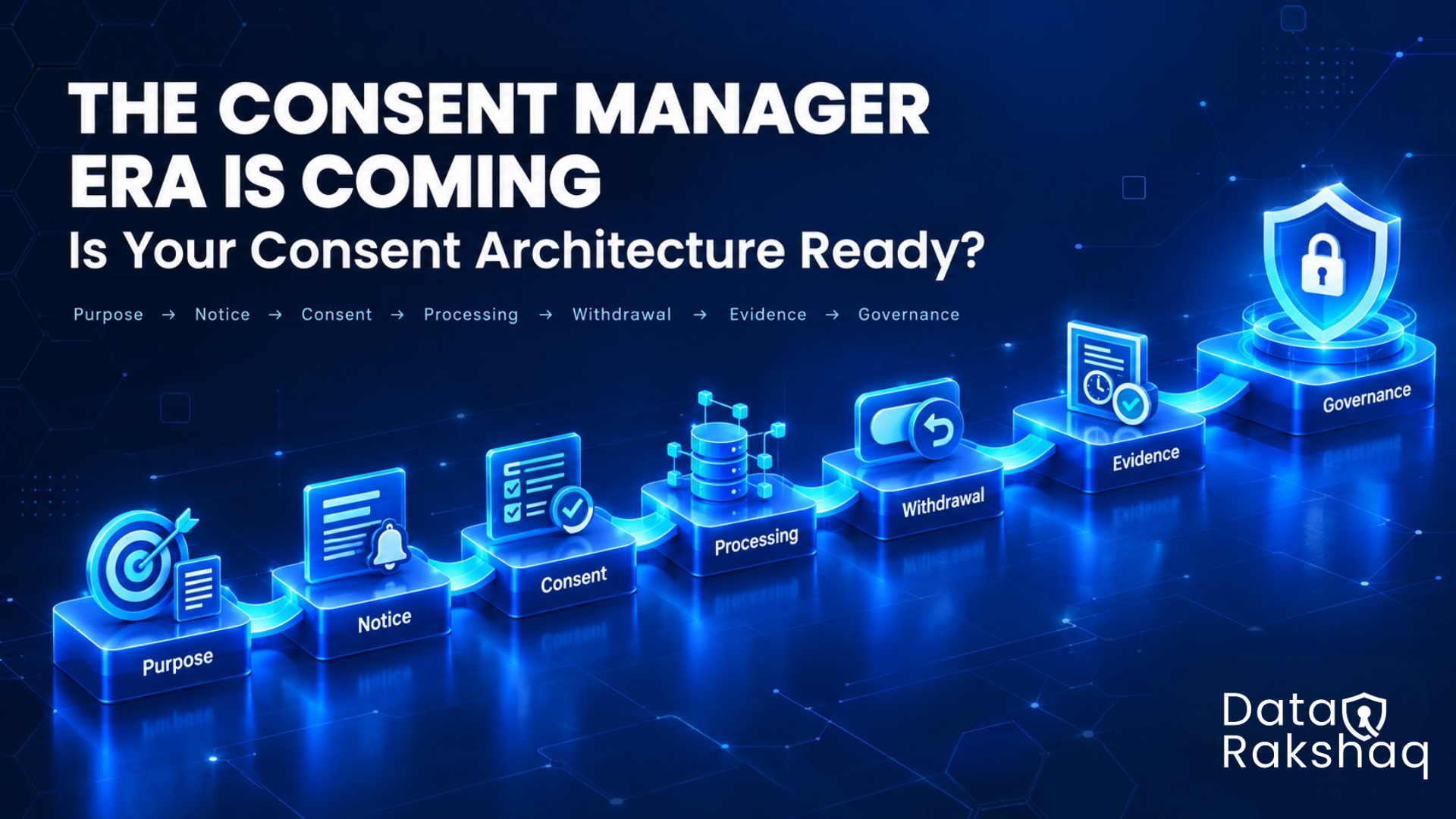
Purpose → Notice → Consent → Processing → Withdrawal → Evidence → Governance
DataRakshaq is built around this lifecycle — helping organisations manage consent across channels, connect consent with processing purposes, operationalise changes, maintain evidence and integrate consent into a broader DPDP compliance framework.
Because the real question is no longer:
“Did the customer click Yes?”
The real question is:
“Can your organisation prove that it knows what that Yes means — and continues to respect it?”
The Consent Manager era is coming.
Is your consent architecture ready?