Introduction: Two Small Wording Changes. Why Should Businesses Pay Attention?
India's Digital Personal Data Protection Act (DPDP Act) framework is moving towards implementation, and organizations preparing for its requirements need to keep track of more than major regulatory announcements. Even small changes to the wording of a law can affect how businesses interpret their responsibilities and prepare their internal processes.
On 5 October 2026, the Ministry of Electronics and Information Technology (MeitY) issued the Digital Personal Data Protection (Removal of Difficulties) Order, 2026, numbered S.O. 5458(E). The Order was published in the Official Gazette in October and addresses two specific provisions of the Digital Personal Data Protection Act, 2023.
The changes concern consent relating to children and certain persons with disabilities, and periodic data audits for Significant Data Fiduciaries.
Although the changes are limited, they raise important questions for organizations reviewing their consent procedures, data-governance documentation and audit planning.
So, what exactly has changed—and what should businesses do about it?
What Is the DPDP (Removal of Difficulties) Order, 2026?
The Order was issued under Section 43(1) of the DPDP Act, which empowers the Central Government to address difficulties in giving effect to the Act through an order published in the Official Gazette.
According to the Order's explanatory text, the corrections address textual and editorial difficulties in two provisions.
The first relates to Section 9(1), which concerns the processing of personal data of children and people with disabilities who have lawful guardians.
The second relates to Section 10(2)(c)(ii), which concerns periodic audits by Significant Data Fiduciaries.
The purpose of these corrections is to clarify the intended wording and reduce ambiguity in interpreting the provisions.
The important distinction: This is a targeted correction to the Act, not a completely new set of DPDP compliance requirements.
Official resource: Digital Personal Data Protection (Removal of Difficulties) Order, 2026 — MeitY
Change One: Clarifying Section 9(1) on Consent
What has changed?
Section 9(1) deals with obtaining verifiable consent before processing personal data of a child or a person with a disability who has a lawful guardian.
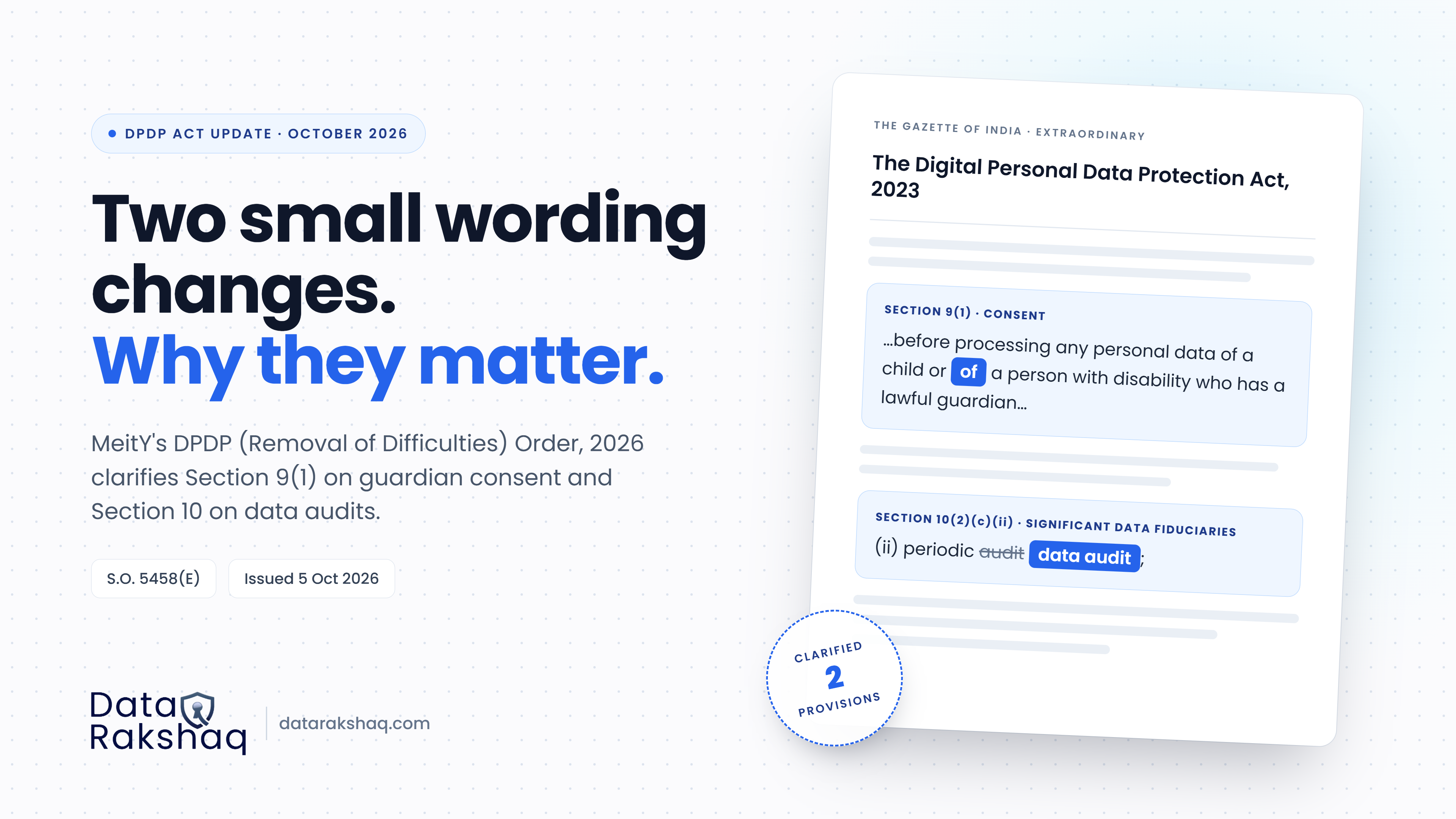
The October Order changes the wording from:
“Child or a person with disability”
to:
“Child or of a person with disability”
The addition of the word “of” clarifies the intended relationship between the two categories mentioned in the provision.
The Order's explanatory text identifies the earlier wording as a source of ambiguity.
Why does this matter to organizations?
Businesses that process personal data relating to children or people with disabilities who have lawful guardians should ensure that their relevant procedures accurately reflect the applicable legal requirements.
For example, an organization may need to review:
How it identifies situations in which parental or lawful-guardian consent requirements apply.
How it verifies and records the relevant consent.
Whether its internal procedures accurately reflect the applicable requirements.
Whether the teams responsible for collecting personal data understand the relevant distinctions.
The objective is not to assume that every person with a disability automatically requires guardian consent. The provision specifically refers to a person with a disability who has a lawful guardian.
The takeaway: Consent procedures should be based on the applicable legal requirements and the circumstances of the individual—not assumptions.
Change Two: Section 10 Now Refers to a “Data Audit”
What has changed?
The second correction concerns Section 10(2)(c)(ii), which addresses periodic audits by Significant Data Fiduciaries.
The Order replaces the word “audit” with “data audit”, making the wording consistent with Section 10(2)(b), which already refers to an independent data auditor carrying out a data audit.
This clarification helps distinguish the intended scope of the audit requirement and reduces ambiguity arising from the earlier wording.
What does this mean for businesses?
Section 10 sets out additional obligations for Significant Data Fiduciaries—organizations that the Central Government may notify as such under the Act.
For organizations that are designated as Significant Data Fiduciaries, audit planning should account for the applicable requirements concerning data audits.
Practical areas to review include:
Whether relevant personal-data processing activities are documented.
Whether responsibilities for audit preparation and coordination are clearly assigned.
Whether supporting records can be identified and made available for review.
Whether findings can be tracked and addressed through a structured process.
These are practical preparation measures, not a claim that the October Order independently introduced each of these activities as a new obligation.
The takeaway: Audit readiness depends on more than scheduling an audit. Organisations also need reliable information about their data-processing activities and a clear approach to documenting and addressing findings.
What Should Organizations Review After This Update?
The Order makes two specific wording changes. Businesses should therefore focus their immediate review on the affected provisions rather than assume that every aspect of their compliance programmed needs to be redesigned.
Here are four practical steps to consider.
Step 1: Review Relevant Consent Procedures
Organizations handling personal data covered by Section 9 should review their relevant consent and verification procedures against the updated statutory wording and the applicable Rules.
The aim is to ensure that procedures reflect the relevant legal distinctions and are understood by the teams responsible for implementing them.
Step 2: Check Data-Governance Documentation
Review whether your organization has a structured understanding of the personal data it processes, the purposes of processing and the systems or business activities involved.
Accurate documentation can help teams understand their current practices and prepare for relevant assessments.
Step 3: Review Audit Planning Where Applicable
Organizations that are designated as Significant Data Fiduciaries should examine the applicable data-audit requirements and ensure that relevant responsibilities, documentation and preparation activities are appropriately organized.
Other organizations can use this as an opportunity to assess their broader data-governance practices without if the additional Section 10 obligations automatically apply to them.
Step 4: Track the DPDP Implementation Timeline
The Act and Rules have a phased commencement framework. The October Order does not itself bring the substantive obligations in Sections 9 and 10 into force earlier.
Organizations should therefore distinguish between provisions that are already in force and provisions scheduled to commence later.
Following official notifications and commencement dates is essential to creating an accurate compliance plan.
Reference: Digital Personal Data Protection Rules, 2025 — Official MeitY document
What the October Order Does—and Does Not—Change
Regulatory updates can easily be misunderstood when short summaries circulate without the full context. It is important to separate what the government has changed from what organizations may choose to review as part of their preparation.
What the Order changes
It clarifies the wording of Section 9(1) concerning personal data of a child or of a person with a disability who has a lawful guardian.
It replaces “audit” with “data audit” in Section 10(2)(c)(ii).
It takes effect in accordance with its commencement provision upon publication in the Official Gazette.
What the Order does not do
It does not introduce an entirely new DPDP compliance framework.
It does not, by itself, bring the substantive obligations in Sections 9 and 10 into force earlier.
It does not establish that every organization is a Significant Data Fiduciary.
It does not replace the need to examine the Act, applicable Rules and subsequent official notifications.
The practical lesson is straightforward: organizations should understand the actual scope of each regulatory update before deciding what action is required.
How Can DataRakshaq Help Organizations Prepare?
Understanding a regulatory update is the first step. The next is understanding how it relates to your organization’s existing data practices.
Businesses need visibility into the personal data they handle, structured documentation of their processing activities, and a way to identify areas where their governance practices may need improvement.
This is where a structured data-governance approach can make a difference.
DataRakshaq offers capabilities that can support organizations as they review and strengthen their data-governance practices.
Data Lens: Discover and Classify Personal Data
Before reviewing data-governance practices, organizations need to understand where personal data resides and how it is handled.
DataRakshaq's Data Lens supports data discovery and classification across relevant data sources, helping organizations build a clearer picture of their data landscape.
How this helps: Better visibility can support informed reviews of data-handling practices and help teams identify areas requiring further attention.
Consent Management: Organize Consent-Related Workflows
Section 9 highlights the importance of understanding the applicable consent requirements for processing personal data relating to children and persons with disabilities who have lawful guardians.
DataRakshaq's Consent Management module supports consent-related workflows and records, helping organizations take a more structured approach to consent management.
How this helps: Organizations can review their existing consent processes and identify where procedures or documentation may need attention. Legal interpretation and the appropriate verification of consent remain the organization’s responsibility.
RoPA: Maintain Structured Processing Records
Understanding what personal data is processed, why it is processed and which business activities are involved is an important part of data governance.
DataRakshaq's Records of Processing Activities (RoPA) module supports structured documentation of personal-data processing activities.
How this helps: Organized processing records can support internal reviews, governance coordination and preparation for relevant assessments.
Gap Assessment: Identify Areas That Need Attention
Organizations may have policies and procedures in place but still need to evaluate whether their current practices align with their intended governance approach.
DataRakshaq's Gap Assessment module supports the assessment of existing practices and the identification of potential governance gaps.
How this helps: Organizations can use assessment findings to identify improvement areas, priorities follow-up actions and assign responsibilities.
Bringing It All Together
The October Order makes two targeted wording corrections. DataRakshaq does not replace the need to interpret those changes correctly or determine which legal obligations apply to an organization.
Instead, its modules can support the broader work of understanding personal data, organizing processing records, managing consent-related workflows and assessing governance practices.
For organizations preparing for the DPDP framework, the starting point is not simply having a compliance tool. It is having a clear understanding of current practices and knowing what needs attention.
Conclusion: Understand the Change. Assess Your Readiness. Take the Next Step.
India's October 2026 DPDP Order makes two specific corrections: one clarifies the wording of Section 9(1) concerning children and persons with disabilities who have lawful guardians, while the other specifies a data audit in Section 10(2)(c)(ii).
Although these changes are limited, they highlight the importance of following official regulatory updates, understanding their scope and reviewing relevant organizational processes.
Businesses should distinguish between what the Order changes and the broader preparation activities they may undertake to strengthen their data governance.
With capabilities for data discovery and classification, consent management, processing documentation and gap assessment, DataRakshaq can support organizations in building a more structured approach to this work.
Because effective data governance begins with three questions: What data do we handle? How do we manage it? And where do we need to improve?
As India's DPDP framework continues to evolve, organizations that combine regulatory awareness with clear documentation, accountability and ongoing assessment can approach their preparation more systematically.
Ready to take a closer look at your data-governance practices?